Authoritative DNS publishes your zone’s answers; recursive resolvers find and cache those answers for clients.
The delivery model
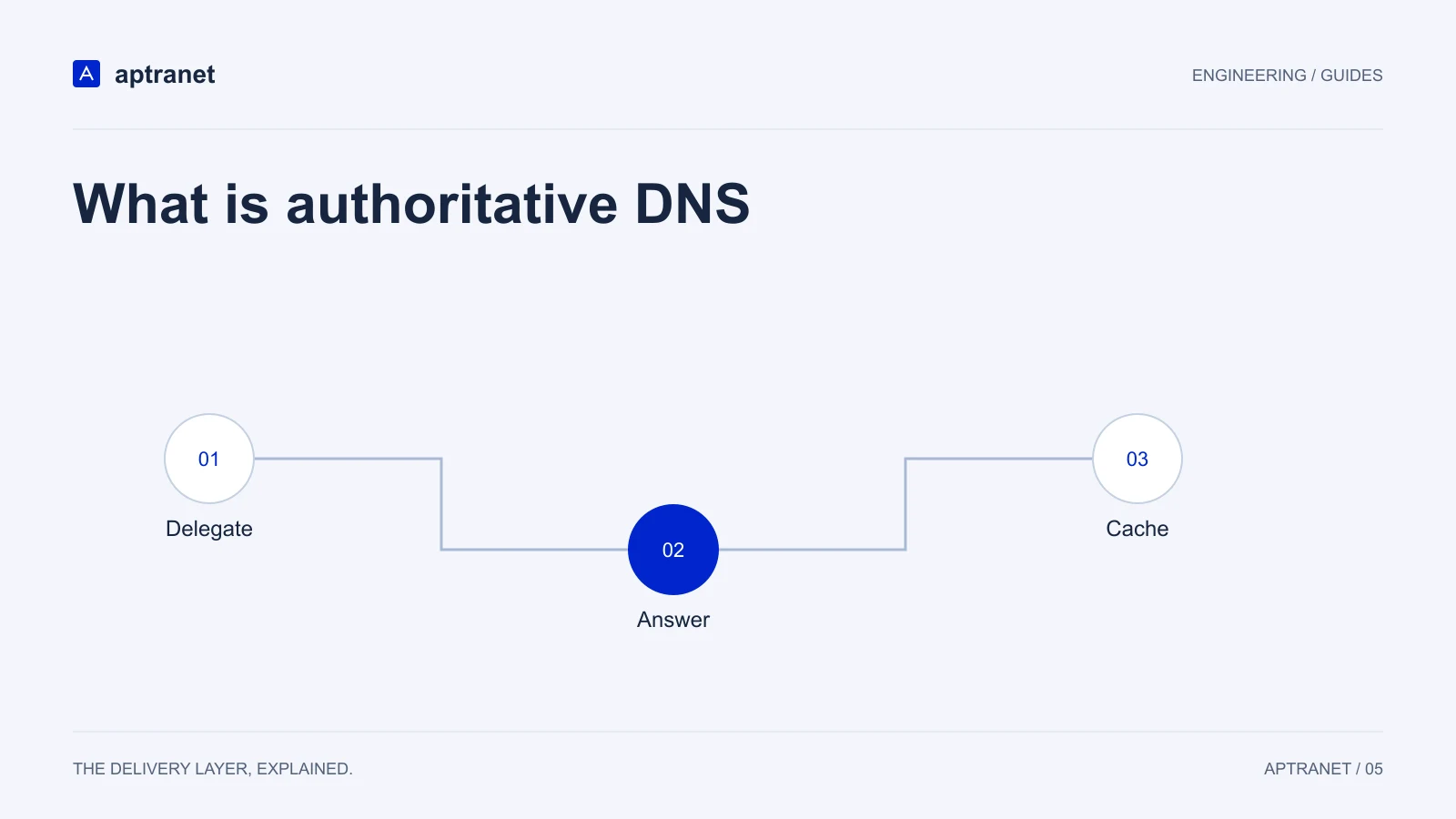
What is authoritative DNS
- 01DelegateThe parent zone identifies the authoritative nameservers.
- 02AnswerAuthority returns a record or a negative answer.
- 03CacheThe resolver reuses the answer within its cache policy.
Why unicast nameservers are a single path
Two nameserver hostnames can still share network or operational dependencies. Anycast can distribute reachability across locations, but provider diversity, zone consistency, and failure handling need their own review.
That is the DNS equivalent of a CDN: the record is the same, the place it is answered from is not.
Records are policy, not just addresses
DNS records describe services and routing policy. A and AAAA publish addresses; additional features may include health-aware answers, geographic routing, and apex aliases. Confirm which features your provider implements.
Registrar DNS is fine for a parked domain. It is a poor control plane for a shop or an API that must move.
Delegation is the cutover
You import the zone, prove records, then change NS at the parent. Mail and verification TXT should be in the imported zone so they do not vanish when NS moves.
Do not mix this up with pointing a single A record at Cloud CDN. That is a record change. Delegation is who is allowed to answer the zone.
Validate before production
Compare the parent delegation with the NS records in the zone. Query every delegated server directly for the same A, AAAA, and MX records. Check DNSSEC validation separately when the zone is signed.
- Record the configuration and expected result before changing traffic.
- Keep evidence of the test and a working rollback for the previous behavior.