A point of presence is useful when its network path, capacity, and cache behavior suit your users; location count alone cannot establish that.
PoP versus a single data centre
A data centre you rent is where the origin runs. A PoP is where the copy runs. Users should meet the PoP; the PoP should meet the origin only when it must.
A provider may operate HTTP delivery and authoritative DNS from distributed locations. Those are separate services, and their actual serving paths should be measured separately.
The delivery model
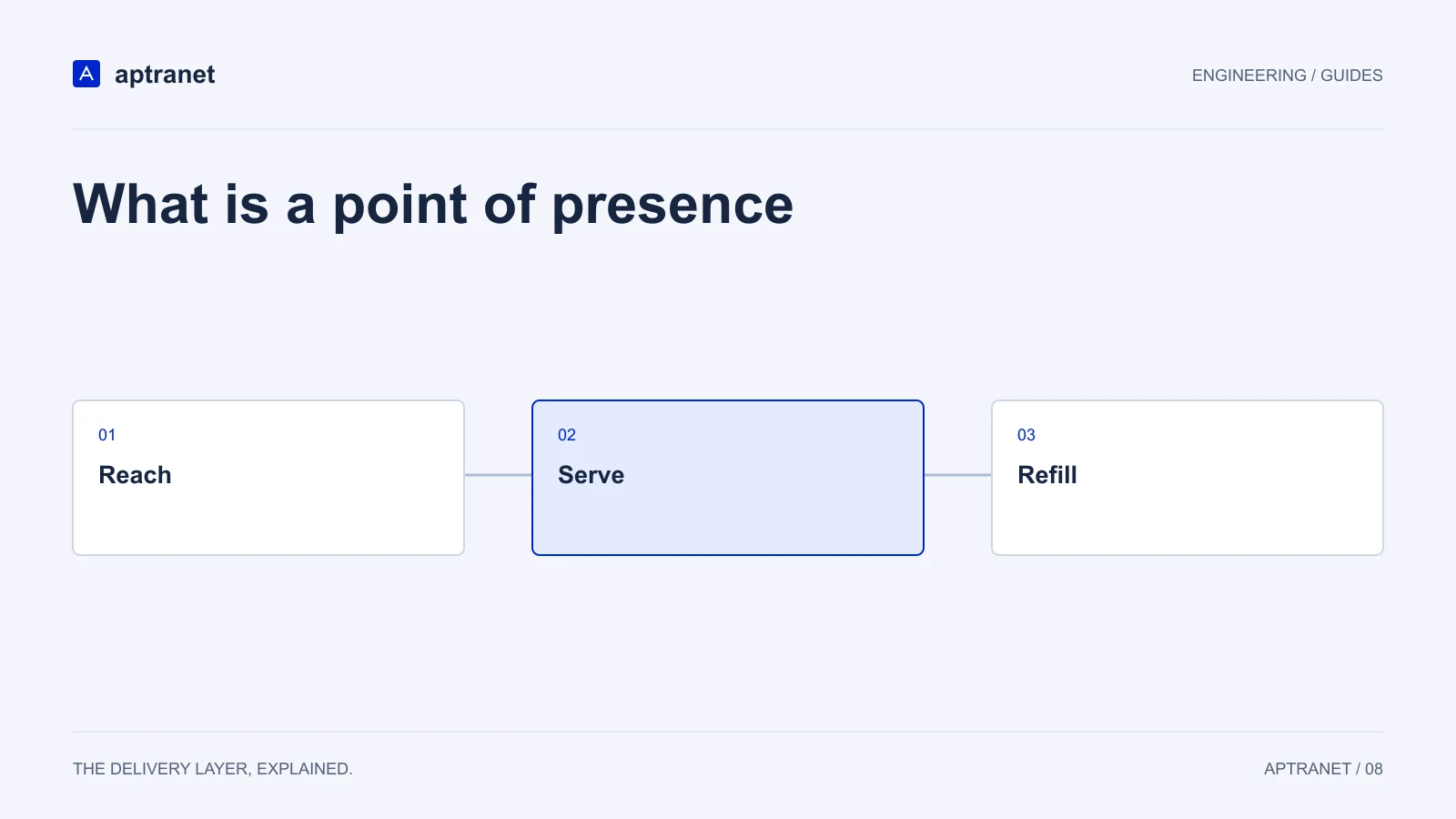
What is a point of presence
- 01ReachRouting sends a client toward a serving location.
- 02ServeThe location terminates requests and may hold cached objects.
- 03RefillMissing content follows the configured upstream path.
Peering determines the network path
Peering and transit relationships influence how requests reach a location. A nearby building can still have a poor network path for a particular access provider.
When you compare vendors, ask about peering and IXPs, not only city pins.
Capacity is the other axis
A live event or software release needs enough delivery capacity for its expected concurrent demand. Check regional throughput and the upstream refill path, not just network-wide totals.
A small cache in many cities still overflows if the object is a 40 GB depot and the launch is global.
DNS PoPs and CDN PoPs
DNS serving locations answer name lookups rather than HTTP requests. Investigate both layers if a page is slow to begin loading.
Put the zone and the distribution on the same footprint when you can.
Validate before production
Identify serving locations using provider diagnostics rather than assuming a nearby city. Compare the same resource across representative regions and access networks. Include an uncached resource to expose the upstream path.
- Record the configuration and expected result before changing traffic.
- Keep evidence of the test and a working rollback for the previous behavior.