Evaluate a CDN using your traffic, update workflow, and failure requirements rather than a map or a headline latency.
Start with the request you actually serve
A documentation site, a WooCommerce catalogue, a Next.js app and a live HLS stream are different jobs. If the vendor only talks about static assets, ask what happens to SSR HTML, Range requests and WebSockets.
Write down what must be cached, what must bypass, and how fast a change must go live. That is the shortlist, not a logo wall.
The delivery model
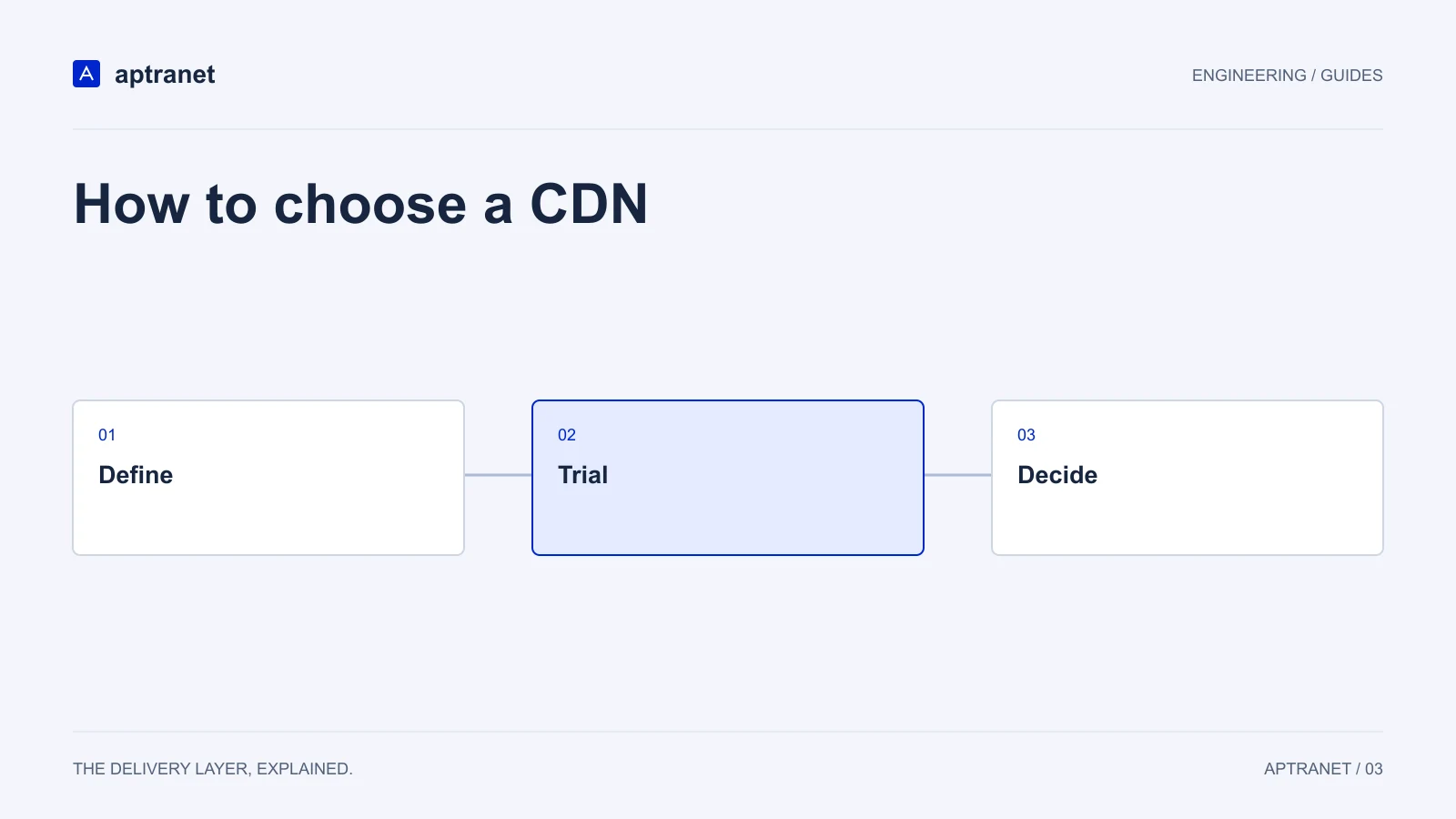
How to choose a CDN
- 01DefineList public, personalized, media, and API request classes.
- 02TrialTest hits, misses, invalidation, TLS, and failures.
- 03DecideCompare measured behavior and total operating cost.
Footprint and the miss path
Network footprint is one evaluation input. Test actual serving paths, connection latency, and throughput in your audience regions rather than treating location count as a performance result.
Ask what happens when many edges miss together. Origin Shield, origin groups and serve-stale are how the origin survives a deploy or a viral URL.
Operations you will perform at 2 a.m.
Test the operations your team will perform: invalidation, prefetching, certificate changes, domain mapping, and log access. Confirm which can be automated and which require provider support.
Cloud CDN exposes distributions, origins, hostnames, cache, purge, prefetch, raw logs and managed or custom TLS in the Management Console and API.
DNS is part of the purchase
Include DNS and certificate preparation in the trial. Apex alias support, TTL planning, and health policy can affect both cutover and rollback.
Cloud DNS is optional. It is also the difference between waiting on registrar TTL and moving when the test hostname is green.
Validate before production
Build a trial using a representative asset, a public page, and a deliberately uncached route. Measure regional latency and origin load, then time a content update and a rollback. Record any capability that needs manual intervention.
- Record the configuration and expected result before changing traffic.
- Keep evidence of the test and a working rollback for the previous behavior.